Why Embedded Is a Better Place for AI Agents Than Web Development
Last updated:
If you’re deciding whether to let an AI coding agent loose on your embedded codebase, the instinct to wait is understandable, but it’s backwards. Most of the visible progress on AI coding agents has happened in web development, so it’s easy to assume embedded is behind and will catch up later, on someone else’s timeline. The opposite is closer to the truth: once the surrounding infrastructure is built the right way, embedded is a better fit for an AI agent than a typical web codebase is, and almost nobody has built that infrastructure yet. That gap is either a cost you keep paying (slower agent adoption, more manual babysitting, a team that stays stuck reviewing everything line by line) or an opening a competitor closes before you do. Stated as plainly as possible: embedded, built the right way, is a better environment for an AI coding agent than web development is — not despite the slower feedback loop, but because closing that gap deliberately is still wide open, while web’s equivalent gap closed years ago.
What “agent-ready” means
An agent-ready feedback loop is the build, test, and verification infrastructure a codebase needs so an AI coding agent can work on it (compile, test, and iterate) without a human re-checking every step by hand. It isn’t a product or a plugin. It’s a property of the codebase itself: either the agent can build and verify its own changes, or it can’t, and every claim in this post follows from that one distinction.
Agents need what developers already need
An agent writing or reviewing embedded code needs the same things a human developer needs to do that work well: a build that reliably reflects what’s on disk, tests that catch a mistake before it reaches a device, and fast feedback on whether a change actually worked. None of that is agent-specific; it’s the same discipline any good engineering team already wants. The difference is that an agent exposes a gap in that discipline immediately, every time, because unlike a human it won’t quietly work around a broken build or a flaky test and move on; it needs the process underneath it to actually be right. That’s the first thing to fix, and fixing it is a one-time cost, not a recurring one: the same build and test setup that makes a codebase reliable for a human makes it usable by an agent at all.
Embedded’s feedback loop isn’t web’s, and that’s the opportunity
Web development’s feedback loop (hot reload, an ephemeral cloud environment that spins up in seconds, a browser that reflects a code change almost instantly) has been optimized for two decades, agent-driven or not. Embedded’s feedback loop runs through a compiler that can take minutes, a physical board that has to be flashed, and test rigs that don’t scale the way a cloud virtual machine does. On the surface, that looks like a disadvantage: slower loops, more physical dependencies, less tooling maturity. But almost nobody has worked out what a fast, agent-driven feedback loop actually looks like under those constraints, which means the field is still open, and the pieces needed to close it already exist; they’re just rarely assembled into one coherent loop. Compile-time checks (verification that happens at build time, before any test runs, catching a class of mistakes before a program even executes), mocked hardware boundaries, software-in-the-loop harnesses (running the software against a simulated environment instead of a physical board), and hardware-in-the-loop testing (running against the real board) used deliberately at the boundary rather than as the default: assembled correctly, this runs faster and catches more than most web teams are used to, precisely because embedded forces a level of discipline that web tooling lets you skip. The gap isn’t a reason to wait; it’s the reason nobody’s captured this yet.
Three ways teams respond to this gap, and only one of them works
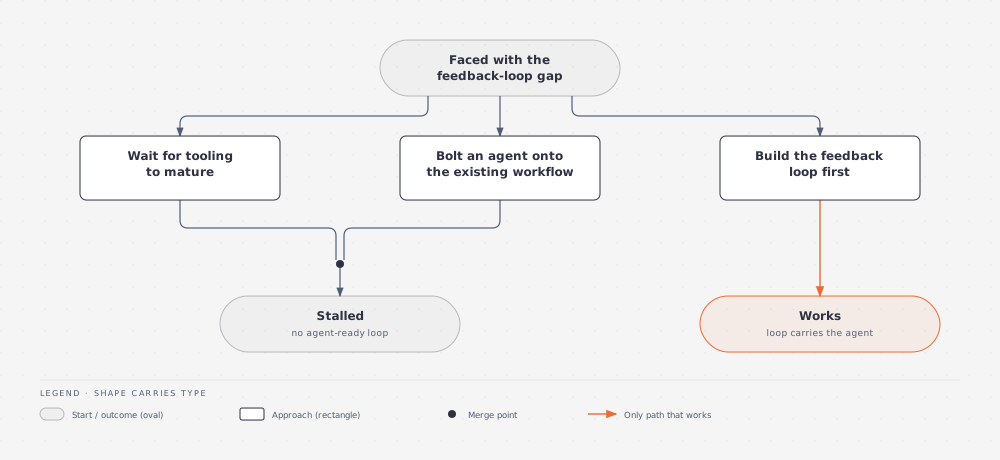
Faced with that gap, teams tend to land on one of three approaches. The first is to wait for the tooling to mature on its own, the way it did for web. This treats embedded as a slower version of the same story, and it isn’t; nobody is building this infrastructure for you, because the market incentive that drove web tooling doesn’t automatically transfer to embedded. The second is to bolt an agent onto the existing setup without changing anything underneath it. This fails fast and visibly, because the agent hits the same build fragility and missing test coverage a new hire would hit, except it hits it on every single task instead of learning to work around it once. The third is to deliberately build the agent-ready feedback loop first (reproducible build, compile-time checks, mocked hardware, a software-in-the-loop harness, hardware-in-the-loop kept at the boundary), and only then let the agent run against it. That third option is the only one that actually works, because it’s the only one that addresses the actual constraint instead of hoping the constraint goes away. Whichever option a team picks, they’ve made a choice about how much of this work happens on their terms versus the agent’s, and only one of those three choices is made on your terms.
C++ gives embedded an edge web doesn’t have
Compile-time testing (writing checks that the compiler itself evaluates and fails on, before a single test runs and before hardware is even involved) is the single technique with the highest leverage in this whole approach, and C++ supports it in a way most web stacks don’t. A compile-time check that a value fits in a fixed-size buffer, for instance, can be evaluated the moment the code is compiled instead of waiting for a test (or a customer) to hit it at runtime. Most web languages don’t have an equivalent: their type systems and tooling weren’t built for this kind of static evaluation, so the same class of mistake that C++ can catch at compile time often survives all the way to a runtime test, or further, in a typical web codebase. Used deliberately, this doesn’t just make the embedded feedback loop different from web’s; it makes it capable of being tighter, because a huge class of correctness checks happen before the expensive parts of the loop (flashing a board, running a physical test rig) ever get invoked. A compile-time check costs milliseconds; a hardware-in-the-loop test costs minutes to hours. Moving a check from the second category into the first is the single highest-leverage change available in this whole approach, and it’s the reason this loop can outperform, not just match, what agent-driven web development is used to.
Agents make the refactor affordable
Getting an existing embedded codebase to this state is usually the actual blocker, not the willingness to do it. Breaking hardware dependencies out of a design, filling in missing tests, and wiring up a real build is exactly the kind of large, mechanical, well-specified work that used to be too expensive to justify against a roadmap already full of feature work. Agents change that calculation directly: what was previously a refactor no team had the budget for becomes something an agent can carry out under supervision, at a fraction of the cost of doing it by hand. That’s what actually opens the door to everything above; none of it matters if getting there isn’t affordable, and for most teams, until now, it wasn’t.
Sequence beats intensity
None of these pieces pay off in isolation, and doing them out of order wastes the investment rather than merely slowing it down. A software-in-the-loop harness built on top of an untested design just automates testing the wrong thing faster. Hardware-in-the-loop testing used as the default instead of the boundary keeps the whole loop slow, no matter how good everything else is. Done in the right sequence (reproducible build first, then compile-time checks, then hardware mocked out, then the software-in-the-loop harness, with hardware-in-the-loop kept deliberately at the boundary), each step builds on the last instead of being redone later, and the pace of progress accelerates instead of staying flat. That first step, the reproducible build everything else waits on, is worth its own treatment; I go through what it means and how to get there in Reproducible Embedded Builds, or Becoming Your Agent’s Synchronization Point. That sequencing, more than any single technique above, is what turns this from a list of good ideas into a feedback loop an agent can actually run.
Where this leaves you
The teams that treat this as an infrastructure problem to solve deliberately, in the right order, will have agents doing real embedded work while everyone else is still waiting for the tooling to “catch up,” tooling that, for embedded specifically, mostly doesn’t need to be invented, just assembled correctly. The gap between “an agent can theoretically write embedded code” and “an agent can build, test, and iterate against your codebase unsupervised” is entirely closed by the infrastructure described above, not by a better model or a better prompt. That’s a decision available to you right now, independent of how mature anyone else’s tooling gets.
Frequently asked questions
What is an agent-ready feedback loop?
An agent-ready feedback loop is the build, test, and verification infrastructure a codebase needs so an AI coding agent can compile, test, and iterate on it without a human re-checking every step by hand. It's a property of the codebase, not a tool you install: either the agent can build and verify its own changes, or it can't.
Why is embedded software development different from web development for AI coding agents?
Web's feedback loop (hot reload, an ephemeral cloud environment, a browser that reflects a change in under a second) has been optimized for two decades. Embedded's feedback loop runs through a compiler, a physical board that has to be flashed, and test rigs that don't scale the way a cloud environment does, so the same fast, agent-driven loop has to be built deliberately instead of inherited from existing tooling.
Can an AI agent work on an existing embedded C++ codebase, or does it need to be rewritten first?
It doesn't need a rewrite, but it does need the surrounding infrastructure fixed first: a reproducible build, hardware dependencies broken out of the design, and a test suite the agent can run itself. That refactoring work is exactly what AI coding agents are well suited to carrying out under supervision, which is what makes it affordable in a way it usually wasn't before.
What makes C++ particularly well suited to AI-agent-driven embedded development?
C++'s compile-time facilities let a large class of correctness checks run at compile time, before a single test executes and before hardware is involved at all. Most web languages don't have an equivalent, so the same mistake a compiler can catch instantly in C++ often survives to a runtime test, or further, in a typical web codebase.
Where should a team start if they want an agent-ready feedback loop?
Start with a reproducible build, since nothing else (no compile-time check, no test, no software-in-the-loop harness) can happen before the code builds reliably. From there, the order matters as much as the pieces: compile-time checks next, then hardware mocked out, then a software-in-the-loop harness, with hardware-in-the-loop testing kept deliberately at the boundary rather than the default.